It cannot read your whole brief
A short prompt or image does not contain every constraint from a production document, art bible, or gameplay requirement.
Workaround: provide focused references and use the result as a conversation starter.
If you are asking what is Sloyd, the short answer is that Sloyd is a browser-based creative workflow for turning prompts, reference images, and adaptable templates into useful 3D starting points. It helps you move from an idea to something visible before committing to a full modeling process.
Sloyd is an AI-assisted 3D creation tool that combines open-ended exploration with more controlled asset-making routes. You can start with text, an image, or a template, then choose the level of structure your project needs.
Describe an object, upload a visual reference, or select a template that already has useful proportions and parts.
Generate variations, compare visual approaches, and decide which shape, style, or construction is worth developing.
Adjust the result, apply a finish, or move the model toward the rest of your 3D workflow for further editing.
The workflow is built around choosing the right kind of starting point. Text is useful when the form is still open-ended. An image gives the system visual information about appearance and proportions. A parametric template is better when you need repeatable geometry and direct controls. Sloyd connects those routes so early exploration does not have to become a dead end.
That makes Sloyd less like a single button and more like a set of connected decisions. You can use AI to widen the search, then use templates or familiar creator tools to add consistency. The result is not just an image of an object: it is a 3D direction that can support concept work, prototyping, game development, printing, or a later handoff.
Sloyd can turn a loose visual thought into a tangible model direction quickly. It is especially useful when you need to compare shapes, communicate an idea, or create a placeholder before investing in detailed production. The before-and-after view below captures the basic distinction: a reference starts the conversation, while a manipulable 3D result gives the team something to examine.
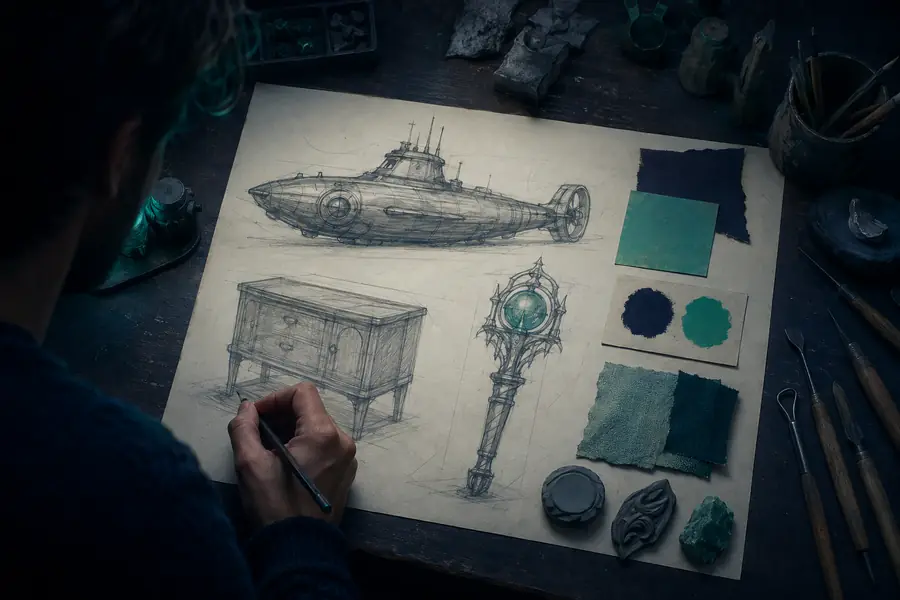
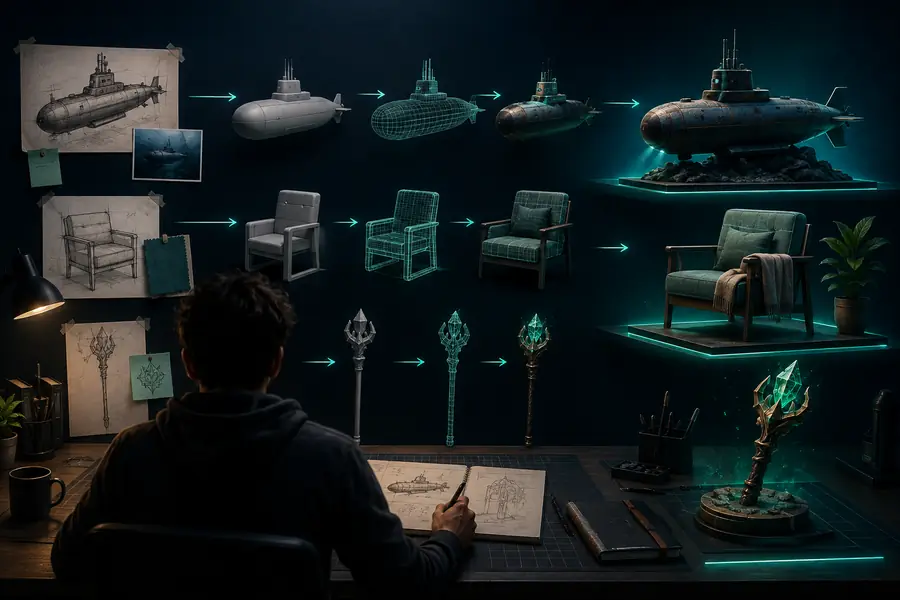
The useful handoff is the movement from visual intention to editable form; the amount of final polish still depends on the asset, the destination, and the work that follows.
Understanding what Sloyd cannot do is part of using it well. It is designed to accelerate the first useful direction, not remove every later creative or technical decision.
A short prompt or image does not contain every constraint from a production document, art bible, or gameplay requirement.
Workaround: provide focused references and use the result as a conversation starter.
Sloyd can offer options, but a person still decides whether the silhouette, style, proportions, and details belong in the project.
Workaround: compare several directions against a clear visual target.
Some models need cleanup, optimization, UV work, rigging, or bespoke topology before they enter a finished pipeline.
Workaround: treat the model as a strong base and continue in a connected creator tool.
Open-ended generation involves variation, and an early result may miss a small but important requirement.
Workaround: iterate, narrow the brief, or switch to a template with more direct controls.
Sloyd fits people who need to make an idea visible before the final production path is settled. Game teams use it for props, environments, and early world-building. Designers and makers use it to test form. Educators use it to explain 3D thinking. Roblox creators, print designers, and small studios value the ability to move quickly without beginning every object from an empty scene.
Creative teams begin using natural language as a faster way to test silhouettes, props, and visual directions.
Image-guided creation makes it easier to carry a sketch, mood, or existing visual language into a 3D conversation.
The most useful pattern combines broad ideation with controlled geometry, giving creators both speed and repeatability.
Teams use an early 3D direction to align on proportion, mood, and scope before choosing the deeper production work.
These numbers describe the shape of the workflow rather than a promise about every output. The right route depends on how much freedom or control your next asset needs.
Why: it keeps the search broad while giving the team something concrete to compare.
Why: the reference gives the 3D direction a visual anchor from the beginning.
Why: control is built into the starting geometry instead of added after the fact.
Sloyd includes AI-assisted 3D generation, but it is broader than a single generator. You can explore with text or images, work from parametric templates, and continue refining the result through a connected creation workflow.
It is best understood as a starting-point and iteration tool. Some outputs can move directly into a project, while others are intended to be cleaned up, customized, or developed further in another 3D application.
Yes. The main Sloyd creation experience is designed for the web, letting you move from an idea to an initial 3D direction without first setting up a large modeling environment.
It can create useful, editable directions and assets, but production readiness depends on the destination and the requirements. Game, animation, and print workflows may still need optimization, topology changes, rigging, materials, or other finishing work.
Common uses include concept exploration, game development, Roblox projects, 3D printing, visual prototyping, and any situation where a team needs to make shape and direction visible early.